

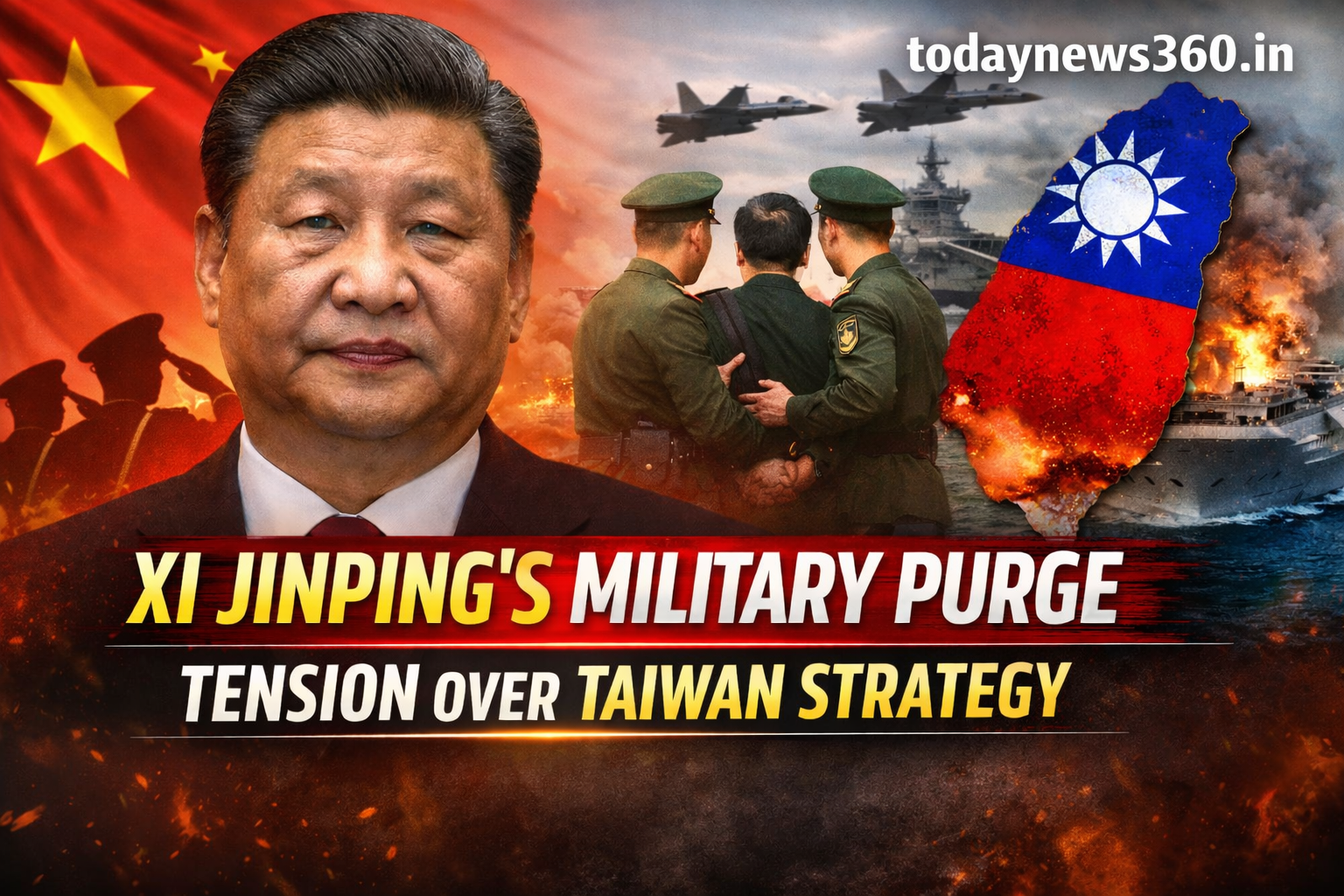
Xi Jinping Removes Top Military Officers Raising Questions Over China Taiwan Policy
Beijing: Major Shake-Up in China’s Military Leadership
Chinese President Xi Jinping has launched a major shake-up in the country’s military leadership by removing and placing senior officers under investigation. This move has raised serious questions about China’s internal stability, military readiness, and future policy toward Taiwan.
According to official sources, two of China’s most powerful military figures, including senior members of the Central Military Commission (CMC), are being investigated for “serious violations of discipline and law.” In China’s political system, this phrase is commonly linked to corruption, abuse of power, or political disloyalty.
The sudden action has surprised analysts, as some of these officers were considered close allies of President Xi.
Who Has Been Removed?
The officers under investigation were among the top leaders of the People’s Liberation Army (PLA). They played key roles in shaping China’s defense strategy, modernization plans, and operations near sensitive regions such as Taiwan and the South China Sea.
These leaders were responsible for overseeing:
- Military training and combat readiness
- Weapons development and modernization
- Strategic planning for regional security
- Coordination with political leadership
Their removal has created vacancies at the highest level of China’s military command.
Reasons Behind the Purge
President Xi has been running a strong anti-corruption campaign since coming to power in 2012. While officially aimed at cleaning up the system, experts believe it also helps Xi eliminate rivals and strengthen personal control.
The current purge is believed to be driven by several factors:
- Anti-Corruption Drive
The government claims that the officers were involved in financial irregularities and misuse of power. - Strengthening Loyalty
Xi wants the military to be fully loyal to him and the Communist Party, especially during times of global tension. - Political Control
Removing powerful figures prevents the rise of independent power centers within the army. - Military Discipline
The leadership wants to send a clear message that no one is above party rules.
Impact on China’s Military
The removal of senior officers may affect China’s military in several ways:
- Temporary disruption in decision-making
- Delays in strategic planning
- Slower modernization in some areas
- Increased pressure on remaining officers
In the short term, military operations may become more cautious as new leaders take charge. However, in the long run, Xi is expected to appoint loyal officials who support his vision.
This could lead to a more centralized and tightly controlled military structure.
Implications for Taiwan Policy
Taiwan remains one of China’s most sensitive political and military issues. Beijing considers Taiwan a part of its territory, while Taiwan operates as a separate democratic government.
In recent years, China has increased military pressure on Taiwan through:
- Air force patrols near Taiwanese airspace
- Naval exercises in nearby waters
- Large-scale military drills
- Cyber and information campaigns
The recent leadership changes have made Taiwan more alert. Officials in Taipei are closely monitoring developments, fearing that internal changes in China could influence future military actions.
Some experts believe that short-term instability may reduce aggressive actions. Others warn that once new loyal commanders are appointed, China may adopt a more assertive approach.
Xi Jinping’s Long-Term Strategy
President Xi has made it clear that he wants to build a “world-class military” capable of protecting China’s global interests. His strategy includes:
- Modernizing weapons and technology
- Improving training standards
- Enhancing joint operations
- Strengthening political control
By removing senior officers, Xi is reinforcing his position as the undisputed leader of both the Communist Party and the armed forces.
Analysts describe this as part of a “one-man command system,” where major military decisions are closely linked to Xi’s leadership.
International Reactions
The global community is watching these developments closely.
- The United States has expressed concern over regional stability.
- Japan and South Korea are increasing security coordination.
- Southeast Asian nations are cautious about rising tensions.
- European countries are calling for peaceful dialogue.
Many experts believe that changes in China’s military leadership could influence security across the Asia-Pacific region.
Broader Political Context
This purge is part of a wider trend in Chinese politics, where loyalty and discipline are given priority over personal influence.
Over the past decade, thousands of officials from different sectors have been punished under the anti-corruption campaign. The military has been a major target, as it controls significant resources and strategic power.
The message from Beijing is clear: even high-ranking generals are not immune from scrutiny.
Conclusion
The removal of top military officers marks a significant moment in China’s political and defense history. It reflects President Xi Jinping’s determination to strengthen his control over the armed forces and ensure absolute loyalty.
While the move may create short-term uncertainty, it is likely to lead to a more centralized military system in the future. At the same time, it has added new uncertainty to China’s Taiwan policy and regional security dynamics.
As tensions continue in the Asia-Pacific region, the world will closely watch how China reshapes its military leadership and how it affects future relations with Taiwan and other neighboring countries.