

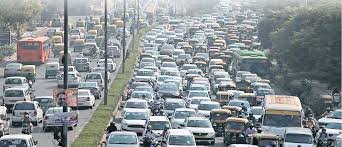
🚗 Low Car Usage, Yet Jammed Roads in Delhi — A Growing Urban Crisis
Despite having one of the most extensive public transport networks in the country, Delhi continues to face chronic traffic congestion. What makes the situation more alarming is that only about 6.4% of Delhi’s population regularly uses private cars, yet these vehicles occupy nearly 90% of the city’s road space, according to recent urban mobility studies.
Experts point out that private cars are among the least efficient modes of transport in terms of road usage. While buses and metro trains carry dozens—sometimes hundreds—of passengers at a time, most cars on Delhi’s roads carry just one or two people. This mismatch between road space consumption and passenger capacity has turned peak-hour commuting into a daily struggle for millions.
The impact goes far beyond traffic jams. Air pollution levels rise sharply during congestion, as idling vehicles emit higher levels of harmful gases. Fuel wastage also increases, adding to household expenses and India’s overall oil import burden. Health experts warn that prolonged exposure to vehicular pollution is linked to respiratory diseases, heart problems, and reduced life expectancy in urban populations.
Urban planners argue that the root of the problem lies in car-centric planning and weak enforcement of parking regulations. Large portions of public roads are taken up by roadside parking, further shrinking usable road space. In many residential and commercial areas, illegal parking forces pedestrians and cyclists onto busy carriageways, increasing the risk of accidents.
To tackle the crisis, experts recommend a multi-pronged approach. This includes expanding and modernizing public bus fleets, improving last-mile connectivity to metro stations, promoting carpooling, and introducing congestion charges in high-traffic zones. Stricter parking fees and better pedestrian infrastructure are also seen as key solutions.
Authorities have acknowledged the issue, but implementation remains slow. With vehicle ownership in Delhi continuing to rise every year, analysts warn that traffic congestion could worsen significantly unless bold policy decisions are taken soon.
The Delhi case highlights a broader challenge faced by many Indian cities: balancing mobility needs with limited urban space. Without prioritizing sustainable and shared transport, roads may continue to remain jammed—even when most people aren’t using cars at all.